Why protect the Pyrenean mountains and the Canal Roya valley?
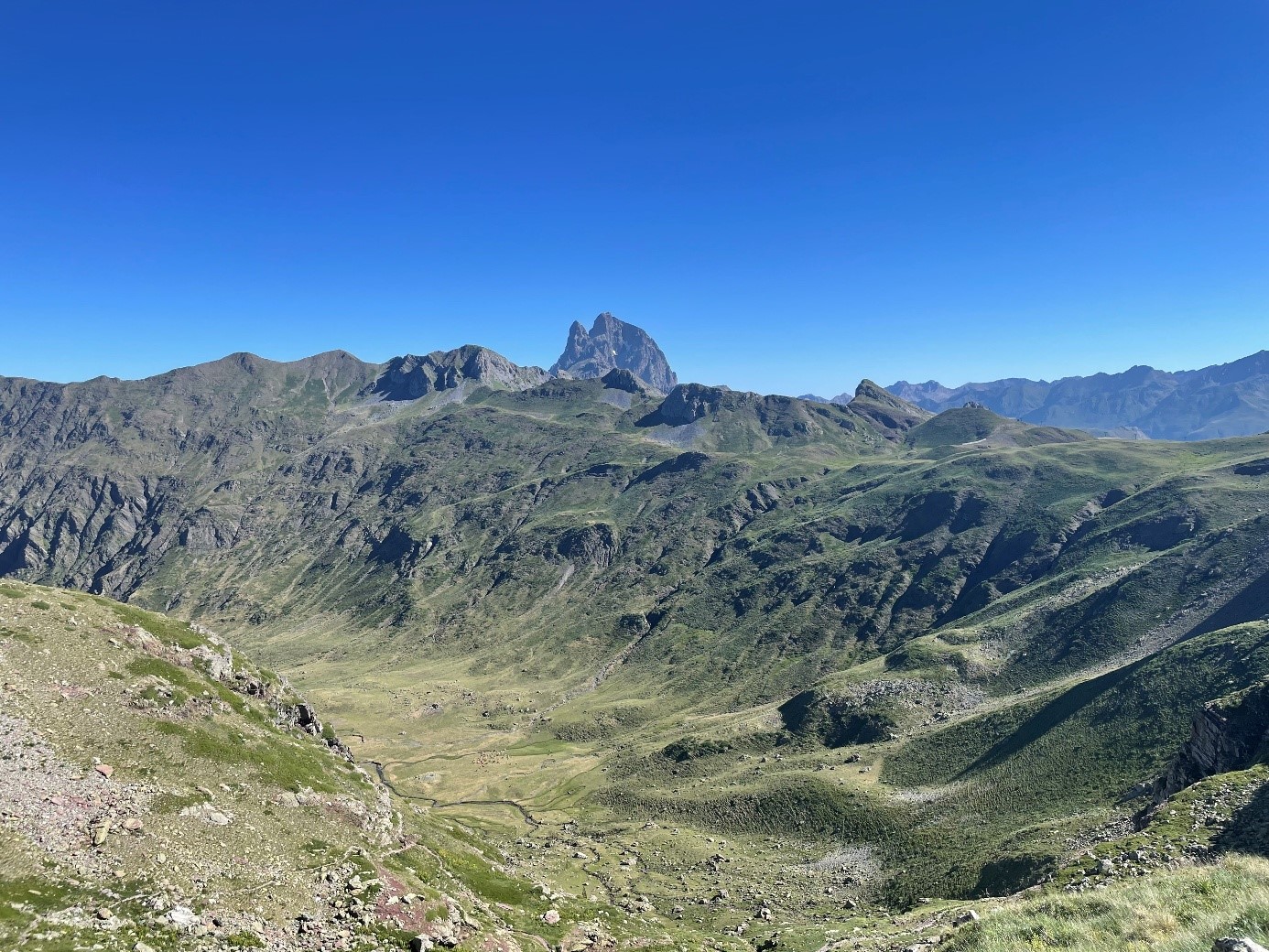
The following paper was written in Spanish for the Canal Roya 2026 Pyrenean Congress held on 17-19 April 2026, in Jaca (Spain). You can read the original version here.
GETTING OUT INTO THE MOUNTAINS FOR FUTURE GENERATIONS AND NATURE
Borja Antolín Tomás (President of Mountain Wilderness Spain), Alba Martínez Picó (President of Mountain Wilderness Catalonia), Fiona Mille (President of Mountain Wilderness France) and Gabriella Suzanne Vanzan (President of Mountain Wilderness International).
Mountains are not merely concentric lines on a topographical map where infrastructure can be placed; they are a space where wild nature and human activities can coexist. For those of us who have walked and lived in the mountains, we might say that, from an emotional point of view, these concentric contour lines on the topographic map are rather open curves on the map of our memories, where the lines intertwine, linking people who love these natural areas with their experiences of the landscape through flowers, granite ridges, snow corridors, friendships, fossils found, watercolours, nights under the stars, sightings of chamois and much more. Wild mountains are a mirror of our civilisation, and 39 years ago our international association, Mountain Wilderness, defined the term ‘mountain wilderness’ as ‘any untouched mountain environment where anyone who so wishes may come into direct contact with the wide-open spaces, experience solitude, silence, rhythms, natural dimensions, laws and dangers. Thus, they are spaces for exploration, discovery and originality, and a source of creativity and culture.
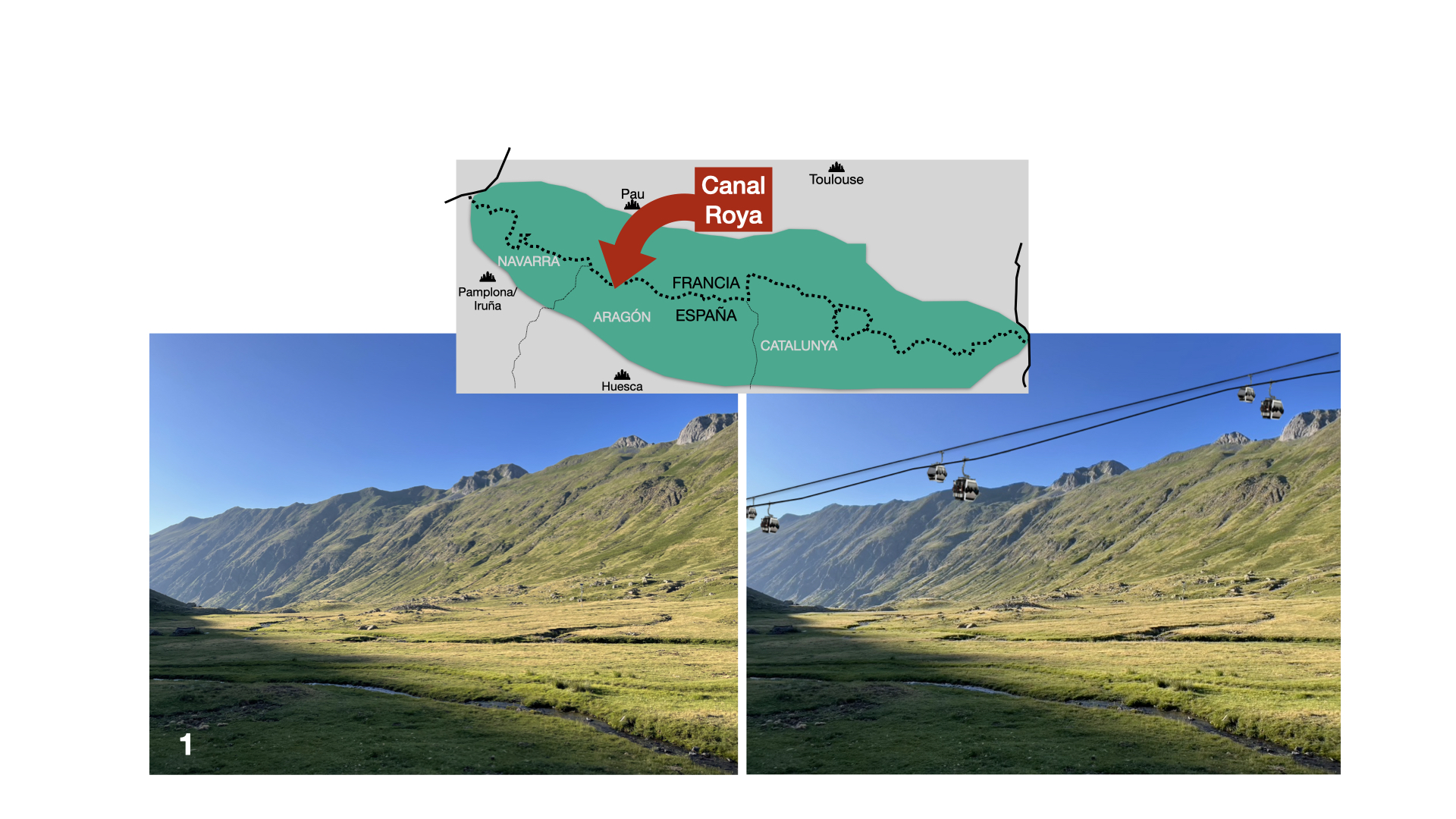
In our Pyrenees, the ‘wilderness’ is a patchwork, tattered tapestry. From west to east, we find numerous examples of the mountains being left unprotected. Among these, we highlight: the magnesite mine in Erdiz (Navarre), the Astún-Candanchu cable car (Aragon), the Formigal-Astún cable car via the Canal Roya (Aragon, photo 1), the Raca-Astún viewpoint (Aragon), the abandonment of the Panticosa Spa (Aragon), the Benasque-Cerler cable car (Aragon), the Valter cable car connecting the village of Setcases with the Vallter ski resort (Catalonia), climbing bans (Catalonia), rubbish and derelict facilities (throughout the Pyrenees), illegal snowmobile activities in Barège/La Mongie (Hautes-Pyrénées) or the mega-reservoir at Roc D’Aude to supply snow cannons at the Les Angles alpine ski resort (Pyrénées-Orientales).
For approximately 70 years, the mountains have been colonised by the industrial world, which has been creating consumer products such as mechanised toboggans, environmentally harmful competitions and new cable cars, with a clear focus on short-term profit and a disregard for the need to adapt to the current problems facing the Pyrenees: rising average annual temperatures, loss of biodiversity, overcrowding and a decline in the quality of life for its inhabitants. As the artist, photographer, explorer and member of Mountain Wilderness, Samivel, would have said over 50 years ago, these structures have only one purpose: a new way of making money.
On the other hand, we increasingly need the mountains for our physical and mental health, to escape the noise and stress of a society ever more tied to digital technology and fast-paced lifestyles. “We live in the age of the tyranny of the now, 24-hour news, the latest tweet and the ‘buy now’ button,” according to the philosopher Roman Kezarnik.
At Mountain Wilderness, we believe that these areas should be protected rather than damaged, not least because of the civic right of present and future generations to enjoy the mountains and their ecosystems in their unspoilt state. The problem is that these facilities ruin the valleys and landscapes for those who wish to experience the mountains first-hand. Furthermore, these facilities lead to overcrowding in the wild natural area, which can only sustain a certain number of people without losing its inherent sense of tranquillity and harmony. Even the most well-behaved crowds make it impossible for each individual to experience the most important values of the ‘wilderness’: solitude and silence.
This risk could be addressed through prior reflection: if we suspect that when we use these artificial means to satisfy our curiosity or momentary whim, they entail the destruction of the natural environment and are preventing people who wish to have a natural experience from doing so, we have a moral duty to renounce their use, even if these reasons seem alien to us and we do not fully understand their significance. As suggested by the Italian Carlo Alberto Pinelli, one of the founders of Mountain Wilderness, a civil society should be mature enough to succeed without trampling on the deep-seated feelings of certain minorities.
Eduardo Martínez de Pisón, a leading expert on the protection of Spain’s mountains says that “when a region is viewed and admired as a landscape, it is elevated to a higher level of civilisation”. Calling for certain places, particularly significant for their biodiversity and scenic quality, to remain untouched is not an act of elitist selfishness; it is a democratic issue that concerns all of us who live in the mountains and those who live in the cities.
What mountains will remain for future generations?
This is all the more important when, instead of looking through rose-tinted glasses and adopting a short-sighted view, we start to think about the new and future generations of mountaineers, naturalists, geologists, ecologists and mountain lovers. They need these spaces to admire, be amazed, explore and live in.
It is obvious that walking through the Canal Roya valley whilst seeing pylons dotting the landscape is not the same as experiencing it in its unspoilt state, as it is today (photo 1).
Coming into contact with unspoilt nature and experiencing it in an authentic way without mechanical aids is of greater value than sliding down a 3-kilometre-long slide like the one being built in Panticosa, or looking out from a terrace reached by chairlift, as it requires personal effort and allows us to connect with nature. This authentic contact creates an emotional bond, enhancing our sensory abilities, our self-confidence and our empathy with living beings and the landscape. This last point is crucial given the crisis of biodiversity loss and climate change currently affecting the Pyrenees. Contact with unspoilt nature is essential because it allows us adults, and especially children and young people, to better understand these and other environmental issues in a more accessible and personal way. In the Pyrenees, we are witnessing first-hand how the glaciers of Europe’s highest mountain range are disappearing; according to models by the Cryo Pyr team (CSIC), they will all have vanished within 10 years. Educating young people about nature means offering them better ways to understand and respect the world that surrounds all living beings, and what better way than to give them the chance to discover it for themselves.
The fact is that if future generations do not know the wild mountains, they will not be able to enjoy or protect them, as what is unknown cannot be protected. That is why at Mountain Wilderness we propose adding an Article 55 to the Convention on the Rights of the Child, adopted by the United Nations in 1989: the right to unspoilt nature. It is also important not to forget that mountaineering (alpinism) was recognised in 2019 as Intangible Cultural Heritage of Humanity by UNESCO and defined as “the art of climbing up summits and walls in high mountains, in all seasons, in rocky or icy terrain. It involves physical, technical and intellectual abilities, using appropriate techniques, equipment and highly specific tools such as axes and crampons. Alpinism is a traditional, physical practice characterized by a shared culture made up of knowledge of the high-mountain environment, the history of the practice and associated values, and specific skills. Knowledge about the natural environment, changing weather conditions, and natural hazards is also essential. Alpinism is also based on aesthetic aspects: alpinists strive for elegant climbing motions, contemplation of the landscape, and harmony with the natural environment.” An art which requires the preservation of these spaces for our children, future mountaineers and explorers, and for which responsibility lies with national governments, regional authorities and each and every one of us.
Protecting the common good: ecology + economy + creativity
We also believe there must be a consultation – so far refused by the presidents of the local councils – with everyone who is part of the mountains: those who come on holiday, those who live there, and the younger generations.
As François Labande (founder of Mountain Wilderness France) together with Carlo Alberto Pinelli and Reinhold Messner said: “we must also recognise that we need to think about the chamois, the rhododendrons and the butterflies in order to protect them; without them, the mountains are like an empty shell”.
The holiday industry would have us believe that tourism only exists when it is mass tourism. But this is not true; there is another vision, with initiatives that have existed for years in mountain areas across Europe and which run parallel to nature. Fiona Mille, president of Mountain Wilderness France, in her book “Réinventons la montagne. Alpes 2030: un autre imaginaire est possible” (Reinventing the Mountains. Alps 2030. Another Vision is Possible), explains how the proposal to hold the Winter Olympics in the French Alps will be yet another fiasco for the people of the valleys, and suggests we move away from a narrow view of culture conceived in a consumerist and anthropocentric sense, and instead develop economic activities in harmony with nature and future generations.
Ecology and the economy can go hand in hand when the greed of a few is set aside. In the Pyrenees we already have many examples: birdwatching tourism, eco-friendly restaurants, geoparks, palaeontological museums, summer camps, sustainable cheese dairies, responsible livestock farming and agriculture, nature painting courses, mountain guides, small performing arts festivals and many more, as explained by Eduardo Viñuales in The Guide to Sustainable Tourism in the Central Pyrenees.
The truth is that, until now, economic interests have time and again tipped the balance, and it is high time we all did our bit to tip the scales back towards the ecological side.
The Canal Roya Valley (Aragon). A place to protect
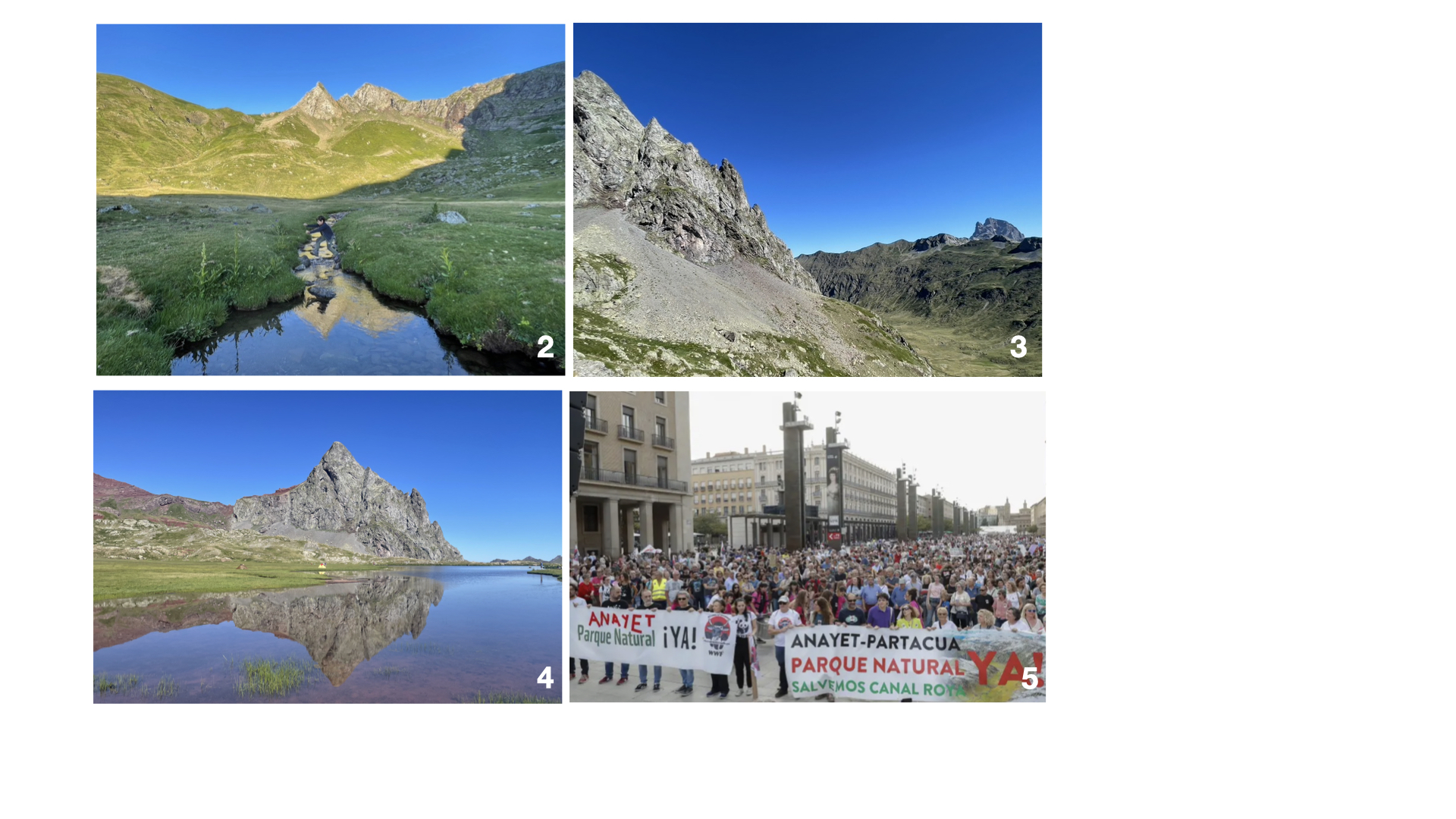
How many mountain areas have we already lost due to the economic interests of a few? The valleys of Castanesa and Espelunciecha were lost to the expansion of alpine ski resorts. And Canal Roya was on the verge of being lost were it not for the hundreds of people who demonstrated alongside environmental groups, organisations, and the work of the Platform for the Defence of the Mountains of Aragon – Canal Roya Assembly (photo 5), who fought and continue to fight for this unspoilt valley adjacent to the French Pyrenees National Park.
The Canal Roya valley, 8 km long, begins at La Rinconada (2,100 m, photo 2), a truly picturesque glacial cirque surrounded by two of the most beautiful mountains in the Pyrenees: the Anayet and the Midi d’Ossau (photo 3). The problem for this valley lies in its location between two alpine ski resorts, Formigal and Astún, owned by the Aramón company. Aramón is a public limited company owned in equal parts by the Government of Aragon and the Ibercaja bank. This construction project contravenes the Natural Resources Management Plan and the United Nations Espoo Convention on Environmental Impact Assessment in a Transboundary Context (1991, ratified by Spain in 1997). This 3.6 km cable car, with cabins capable of carrying 10 people, would completely alter the landscape of the valley, which is a popular area for national and international mountaineers as the GR11 trail passes through here (photo 2). And not only visually; the cables are expected to affect the acoustics of the valley and the birdlife. It is therefore essential that this entire unprotected area be designated a Natural Park.
We need the beauty of the mountains. We must reclaim a way of thinking that does not take a confrontational stance towards nature. We will not give up on the mountains. As Carlo Alberto Pinelli once said, “Let us not miss this opportunity afforded to us by our Homo sapiens brains; do not be selfish and think only of your own financial gain, but think also of the mountains, their living creatures and their beauty.” Up there lies a world of open spaces, free-flowing waters and innocent animals, a world that still shines, as Samivel used to say. It is up to us, and us alone, to keep it alive. The struggle to preserve the Canal Roya valley with all its wilderness is already a symbol of the unity of those who love the Pyrenean mountains. Let us remain united and mountain-bound, resisting abuse and injustice, for mountains full of nature for future generations.
References in order of citation occurrence
Carlo Alberto Pinelli. Foreword in: François Labande. Sauver la montagne. Pub: Olizane. 2004. Roman Kezarnik. Last Ancestor. Pub: Capitán Swing. 2022.
François Labande. Sauver la montagne. Published by Olizane. 2004.
Eduardo Viñuales Cobos. Guide to Sustainable Tourism (II) Central Pyrenees. Published by SUA. 2025. Samivel. Men, Peaks and Gods. Published by Arthaud. 2005.
Fiona Mille. Reinventing the Mountains. The Alps in 2030: a different vision is possible. Published by Faubourg. 2024.