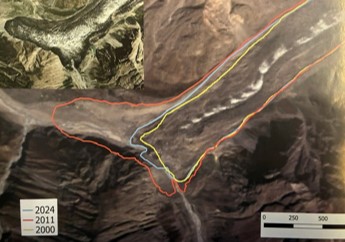
May/June: Medvezhiy Glacier
The Medvezhiy Glacier lies on the western slope of the Tajik National Academy of Sciences Range, in the heart of Tajikistan’s Pamir Mountains. Its highest point reaches 4,680 m asl, and the glacier extends for 15.8 km with an area of approximately 25.2 km².
In early summer 2011, the Medvezhiy Glacier underwent a sudden and dramatic surge down its valley, surpassing the extent of its previous major surge by at least 22 years. This abrupt movement raised serious concerns among glaciologists and emergency management groups about the risk of a potential glacial lake outburst flood that could inundate the Vanch River valley.
Satellite imagery and reports from local scientists indicate that the glacier advanced between 800 and 1,000 m between June and July 2011, compared with its typical annual advance of 200-400 m. The glacier’s terminal moraine blocks the Abdukagor River and has created a lake which can reach up to 20 million cubic meters in volume during major glacial surges. It is likely that cracks and subglacial tunnels are allowing water to pass through the area. A bridge downstream was destroyed by a single water surge.
Tajikistan hosts some of Central Asia’s largest glaciers, which play a crucial role in the country’s water system. However, climate change has caused widespread glacier shrinkage. Since the 1960s, the country is estimated to have lost up to 1,000 glaciers. Under all climate scenarios, glaciers are expected to continue retreating steadily, with total ice volume potentially declining by more than 50% by the end of the century – a trend clearly reflected in hydrological models.
Glaciers in Tajikistan are unevenly distributed, with the highest concentrations in the Pamir and Tien Shan ranges, particularly in the Gorno-Badakhshan Autonomous Region (GBAO). These glaciers are vital sources of water for Tajikistan’s major rivers and for neighbouring countries. Low-altitude glaciers are melting rapidly, while high-altitude glaciers are also retreating, though at a slower pace, as temperatures continue to rise.