Thousands block Austria’s Brenner motorway to protest rising traffic noise and pollution
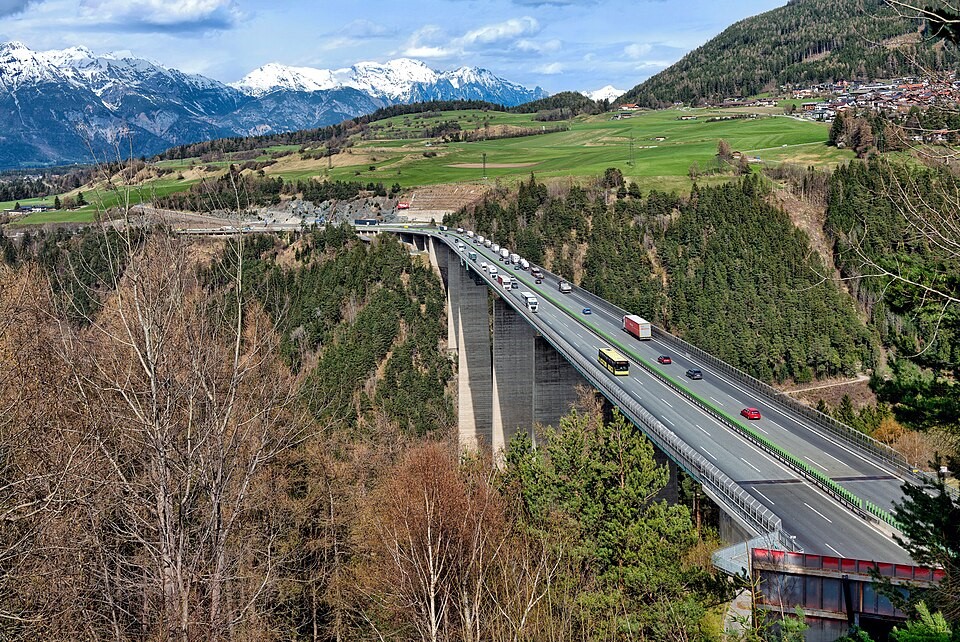
On Saturday 30 May, a protest against noise and pollution blocked one of Europe’s most important highways connecting Germany and Italy. Several thousand protesters gathered on the Brenner motorway to demand action.
The Brenner Pass links northern and southern Europe, with the Austrian stretch providing vital trans-Alpine access into Italy. Communities in Austria’s western Tyrol province have long complained about traffic on the route, especially trucks passing through the province. They call for an end to pollution, noise and traffic jams.
Asfinag, the Austrian motorway operator, reports that traffic has been rising steadily for years, with the number of lorries more than doubling since 2000. In the past year alone, the route was used by nearly 11 million cars and 2.5 million vans and trucks
In 2023, Austria unilaterally adopted four sets of measures to tackle the problem: a night-time transit ban for commercial vehicles; a sectoral ban restricting road transport of specific types of goods with the declared aim of encouraging a shift to rail; seasonal and peak‑period bans during winter and heavy‑tourism weekends; and a traffic‑dosing system limiting heavy‑vehicle flows from the A12 to the Brenner Pass. Tyrol’s 2026 plan foresees about 30 dosing days managed by Asfinag.
In 2024, Italy brought the case before the European Court of Justice (ECJ), based in Luxembourg, arguing that the measures restrict the free movement of goods guaranteed by Articles 34 and 35 of the Treaty on the Functioning of the European Union. Austria is the defendant in the case, while the European Commission has intervened in support of Italy.
On Tuesday 21 April 2026, a hearing was held in the ECJ. The Advocate General’s conclusions are expected on 16 July. The Luxembourg panel’s ruling is expected by the end of the year. The Italian Ministry of Infrastructure and Transport expressed its strong expectation for a positive solution to the dispute to re-establish legal certainty and more favourable conditions for road hauliers.
The European Union aims to shift a significant portion of freight transport from road to rail, targeting a 30% rail share by 2030 and a doubling of rail freight by 2050, this initiative being a core pillar of the European Green Deal. Yet freight transport in Europe remains dominated by road, with 78% of goods moving by truck and only 17% by rail.
The situation in Italy is even worse: in 2025 the road share rose to 88%, while rail dropped to 12%, confirming the country’s difficulties in meeting the sustainability targets set by the European Union. Rail freight transport in Italy ended 2025 with 49.4 million train-km, down 3.5% from 51.2 million in 2024, the decline forming part of an overall contraction of 7.8% since 2022.
In an open letter to EU Commissioner Tzitzikostas and Alpine transport ministers, 67 organisations – including several chapters of MW as well as Mountain Wilderness International – led by CIPRA International, warned that a ruling against Austria could weaken or block environmental and health‑protection measures on Alpine transit routes. This would favour road freight over rail, undermine EU environmental goals, and risk future protective measures being overridden by the principle of free movement of goods.
On the Austrian side, the Federal Government and the Land Tyrol defend the restrictions as indispensable instruments for the protection of public health and air quality in the Alpine valleys, as well as for road safety and traffic peak management. Vienna argues that the measures are proportionate and part of a long-term strategy to encourage a modal shift to rail, consistent with European climate targets and the future full operation of the Brenner Base Tunnel.
Protesters, who have our full support, want to send a clear message to Brussels: the growing traffic burden can no longer continue, as it is severely impacting their quality of life and the fragile Alpine ecosystem.
Which side will Europe choose to be on?